| A Career Alchemist client who recently started in her new executive role with a mid-sized consultancy brought an issue to our coaching.
She wondered how to showcase the hidden value she was bringing to the organization.
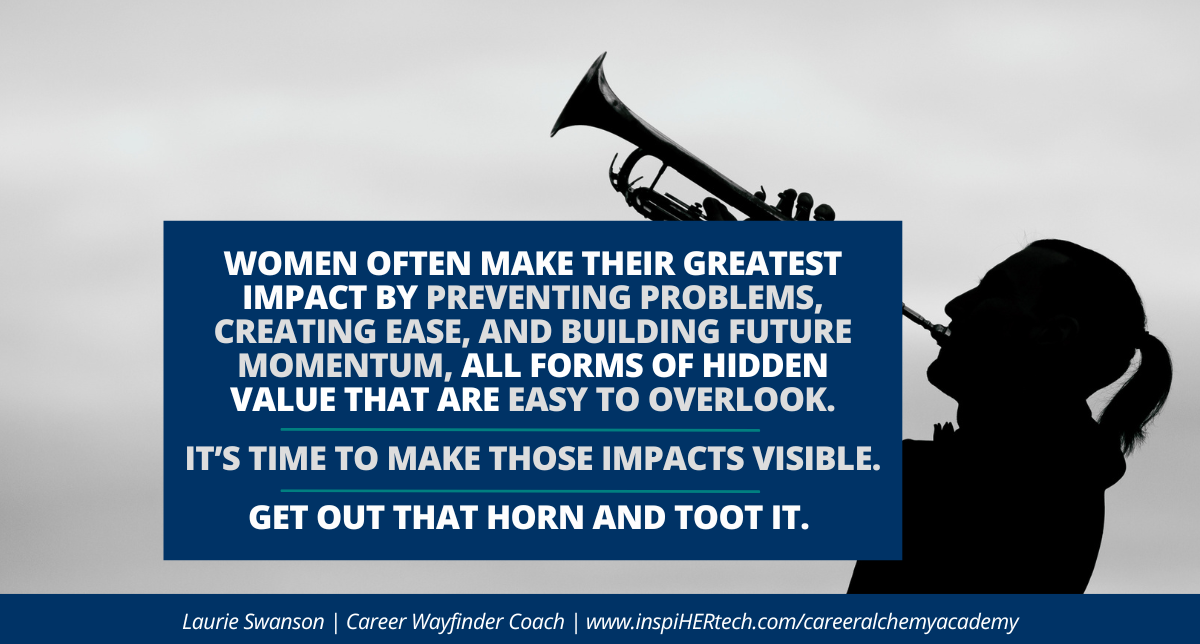
It is important to recognize the often significant yet subtle and hidden value we bring to our roles. We need to find ways to showcase the value we bring in a way that is understood explicitly.
My client works at a consulting firm that places high value on the individual who is billing at a client. She is not in a directly billable role. She was brought in to help build team cohesion and bring AI strategy to the firm. Her focus is expected to create a new way for the organization to offer value to their clients using an AI framework she developed, delivered by high performing teams.
She was hired to create a transformation for the company.
The hiring team recognized that she would not be billable, yet she was now running up against the old “how many hours did you bill” measuring stick and feeling like she has to justify her 40 hours of work.
She wanted to get coaching on how to help others see her hidden and the long-term impact her role would have on the future offerings and bottom-line revenue.
This is something we all should be measuring and communicating. We often have lots of activities that bring great value to our companies but are not recognized because they are not obvious.
Hidden value is the work that keeps things stable, scalable, innovative, and future-focused but often is invisible precisely because it prevents chaos rather than reacting to it.
What makes the recognition of the value of that which is hidden especially powerful is the contrast between:
- What is visible urgency vs what is invisible impact
- What is firefighting vs what is foundational work
- What is measurable output vs what is long-term influence
- What is being loud vs what is creating leverage
Side Story Related to Hidden Value: A coaching client once reflected on her first job. She was a talented software engineer who delivered clean, bug-free code. Her counterpart delivered bug-infested code which meant they were often asking for assistance, taking time from more senior coders and from those on other teams to get their code to work properly and deliver the expected outcomes. In the end, the person with all the bugs was seen as a hard worker who must have more difficult problems to solve. NOT TRUE. Perception is everything!
5 different types of hidden value and the strategies to make them more visible
1. Preventing Problems Before They Happen
Like the clean code example. You are the person who:
- catches risks early
- creates smoother systems
- notices gaps before launch
- asks thoughtful questions
- improves clarity
- creates documentation
- builds sustainable processes
The irony: When things run smoothly, people assume it was easy.
Visibility strategy: Start documenting avoided risks and efficiency gains.
“This new workflow reduced approval delays by 3 days.”
“The updated intake process eliminated duplicate requests.”
“The cleaner architecture reduced downstream revisions.”
Translating invisible stability into business language.
2. Emotional and Relational Labor
Women are often the unofficial culture stabilizers, conflict diffusers, side mentors, and/or onboarding support.
This work absolutely impacts retention, morale, and productivity, yet rarely appears in KPIs.
Visibility strategy: Tie relational work to organizational outcomes.
- improved collaboration
- faster onboarding
- stronger client trust
- reduced escalation
- higher retention
- smoother cross-functional execution
You can say: “I noticed I’ve become a key bridge between departments, which has helped accelerate project alignment.”
Frame your EQ as your leadership super-capability.
3. Strategic Thinking That Has Not Yet Monetized
My client’s AI strategy work is a perfect example. Innovation work often looks “unproductive” before the payoff arrives because foundations are still being built, systems are evolving, adoption takes time, and transformation is nonlinear
Organizations often overvalue immediate revenue and undervalue future positioning.
Visibility strategy: Create milestones for transformation work. Instead of waiting for the final result:
- show pilot progress
- document adoption rates
- track efficiencies
- highlight future revenue opportunities
- present frameworks visually
- communicate strategic readiness
People understand progress better when they can see movement.
4. Quiet Competence
Some people do excellent work without creating noise around it. Unfortunately, workplaces often reward urgency, overextension and/or constant escalation. Meanwhile, the calm high performer disappears into the background.
Visibility strategy: Narrate your work more consistently.
- share project updates
- summarize wins in meetings
- send recap emails
- connect your work to larger company goals
- speak about outcomes, not just tasks
Create visibility around your contribution.
5. Capacity Creation
One of the most overlooked forms of value is creating ease for others by simplifying workflows, creating templates, improving communication, reducing confusion, organizing information and/or helping teams move faster.
The person who creates clarity often saves dozens of hours that nobody tracks.
Visibility strategy: Quantify time, friction, or resource savings whenever possible.
- “Reduced onboarding time by 25%.”
- “Created reusable templates now used across 4 teams.”
- “Centralized resources that reduced duplicate requests.”
Help your organization recognize that ease is valuable.
Hidden value is often invisible because it prevents problems, creates stability, builds trust, or prepares the future. These things are harder to measure or participate in than visible urgency.
The engineer with buggy code looked busy, collaborative, and “needed.” while my client, producing elegant work, looked less valuable because her excellence didn’t require attention.
Start to share your hidden value (and call out the hidden value of others on your team!) during meetings, on performance reviews, in skip level conversations and you will never have to justify your work to anyone because it shines like a beacon for others to get behind and elevate.
|