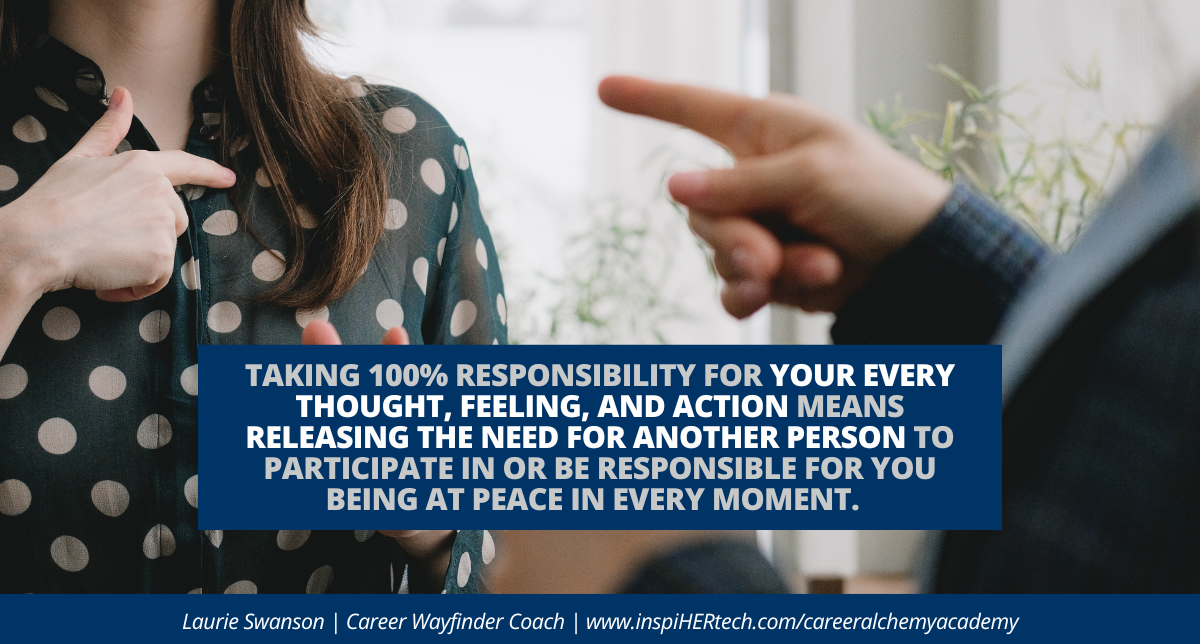
One of the hardest things I’ve ever learned to do was to take 100% responsibility for a conflict while the other person was still actively irritating me.
When the Career Dust-Up Started
Years ago, when I was running my information technology search firm, I was working on a larger strategic plan for the company. I was excited about where we were going and felt a lot of momentum around some changes I wanted to make.
Before our larger company meeting, I sent out an email announcing a couple of changes I wanted to implement right away.
To me, it felt proactive.
To one of my employees, apparently it felt terrible and they were mad.
She responded with a very angry mail, and just like that, I could feel the energy in my body shift.
Immediately I had thoughts like:
- I’m the boss. I get to decide the strategic direction.
- Why is this suddenly an issue now?
- If you wanted more input, why didn’t you say something earlier?
- Why am I getting pushback for trying to move things forward?
And underneath all of that was frustration, defensiveness, disappointment, and honestly some hurt too.
At that point in my life, I had already done years of therapy, coaching work, and personal growth. I was learning how to observe my reactions instead of just becoming them.
And I remember thinking, “Oh. Here’s an opportunity to practice a hard lesson I had learned about taking 100% responsibility when I got that parking ticket and wanted to blame my therapist for it” (Read that story HERE!)
Because it’s easy to talk about taking 100% responsibility when no one is upsetting you.
It’s much harder when you’re mentally drafting rebuttal emails (I did that) while unloading the whole story to your husband over dinner. (Yep, I did that too).
One of the coaching leadership tools I now teach is called The Mindset Method, and it starts with the idea that circumstances themselves are neutral. They are just facts that no one would dispute. Like the temperature outside. It is what it is. It is undeniable.
In this case, the circumstance was: I sent an email announcing changes and my employee was mad.
That’s it.
Everything else, how I was feeling, the actions I took or did not take and the results I was experiencing were all because of how I was thinking about and interpreting the circumstance.
And boy, did I have thoughts.
But if I was going to explore what it means to take 100% responsibility and get to a place of peace (my REAL goal) then I had to take 100% responsibility for my thoughts, feelings, actions and the results I was experiencing.
In the process, one of the things I discovered was that I was completely willing to take 100% responsibility … as long as the other person was also willing to take some responsibility as well. We can see their part and want them to see it too.
But this is not actually me taking 100% responsibility. That’s a negotiation. That’s “I’ll own my part if you own yours.”
What This Career Dust-Up Actually Taught Me
But true 100% responsibility, at least the way I’ve come to understand it, has nothing to do with whether the other person ever changes, apologizes, evolves, or sees your side.
And honestly, that part is just annoying and hard to get past. But you must!
There’s a part of us that really wants the other person to understand our intentions before we let ourselves move on.
But every time I started mentally defending myself, I could feel myself leaving my center of peace.
I would replay the email in my head. Rehearse explanations. Build arguments. Justify my tone. Imagine future conversations.
None of this made me feel better.
It just kept me emotionally hooked.
So, I paused and asked myself:
- Could I have communicated the changes differently? Sure.
- Could I have slowed down and had a conversation first instead of sending an email? Probably.
- Could my excitement and urgency have overridden some awareness? Absolutely.
All true but none of those things required me to become the villain in the story.
That’s the thing I think we get confused about with responsibility.
Taking 100% responsibility does not mean:
- blaming yourself
- collapsing into shame
- pretending the other person had no role
- “falling on the sword”
It means managing your mind and stewarding your emotions so you can remain in your zone of peace.
It means recognizing that your peace cannot depend on someone else suddenly becoming more self-aware.
It means to no longer rigidly defend and justify your stance. Because justification always means trying to win the case.
You cannot get to peace while simultaneously building a case for your innocence or getting others to agree with you, apologize or change.
Trust me, I’ve tried.
What I eventually realized is that taking 100% responsibility is actually incredibly empowering and requires vigilance. We don’t like to look at where we might have had a misstep … especially if it hurt or angered someone else.
When I stop waiting for someone else to change before I can feel better, I get my peace and my power back.
I stop handing my emotional state over to another person’s thoughts, reactions, or level of awareness.
And for me, that’s really what this work is about now.
Noticing when I try to justify, defend, or deflect instead of being 100% responsible for my own thoughts, feelings and actions regarding any and every circumstance and especially when that circumstance involves another human being.
I do my best to remember that peace becomes available the moment I stop requiring someone else to participate in it.
When I take 100% responsibility, I am 100% in the driver seat, 100% empowered and 100% at peace. |