| I went to see Jim Gaffigan at The Chicago Theatre last week.
If you ever get the chance to see him, go. He’s hilarious.
At one point he says, “I struggle with doing nothing. Should I sit down and do nothing… or lie down and do nothing?”
And I felt that in my soul.
Because here’s the thing.
Work is busy right now. Referrals are coming in. Clients are extending. I’m being asked to speak and run workshops. Seeds I planted years ago are finally starting to bear fruit.
It’s beautiful. And… it can feel like a lot.
What’s interesting is that before this season of momentum, there were quieter stretches. More space in my calendar. More room in my days.
And instead of appreciating that space, I felt guilty.
Guilty that I had time.
Guilty that I wasn’t “maxed out.”
Guilty that I wasn’t filling every open hour with something that looked productive.
Because I’m building a business, right? I should be doing more.
The Hidden Cost of Productivity Culture
That word — should — is productivity culture’s favorite weapon.
I see this with my clients all the time.
Women on a job search who feel like if they aren’t applying to 27 roles a day, networking nonstop, and optimizing their LinkedIn at midnight, they’re failing.
Leaders in slower project cycles who feel unsettled when the fire drill hasn’t started yet.
One client recently told me she’d developed a “bad habit.” She was spending longer at lunch watching TV… and then finishing her work at night.
She was confused by it.
I wasn’t.
Because I see this pattern constantly.
When There’s No Deadline, Create One
When the external structure disappears — the deadline, the urgency, the meeting overload — we don’t suddenly relax.
We panic.
Productivity culture has trained us to associate worth with visible output. If no one is watching the clock or breathing down our neck, we manufacture pressure. We delay during the day so we can recreate urgency at night.
It’s not laziness.
It’s conditioning.
We talked about how uncomfortable it felt for her to work differently. To put her feet up when the project hadn’t fully kicked off. To admit that the work could be done in less time … and that didn’t make her less valuable.
How to Use a Slower Season in Your Career
So instead of trying to “push harder,” we did something counterintuitive.
We created structure that included downtime.
Walking.
Learning through a podcast.
Intentional white space.
Not as a reward (which was how I used to justify my downtime) but as part of the agenda.
A different kind of fire.
She said, “I feel activated again.”
Not because she was cramming more in but because she stopped fighting the space.
There Are Seasons of Planting, Harvest… and Quiet
Here’s what I’m learning (again):
There are seasons of planting.
There are seasons of harvest.
And there are seasons of quiet.
If we rush to fill every quiet moment, we never actually experience it. And then when life gets loud again, we’re already depleted.
Doing nothing is not the same as being nothing.
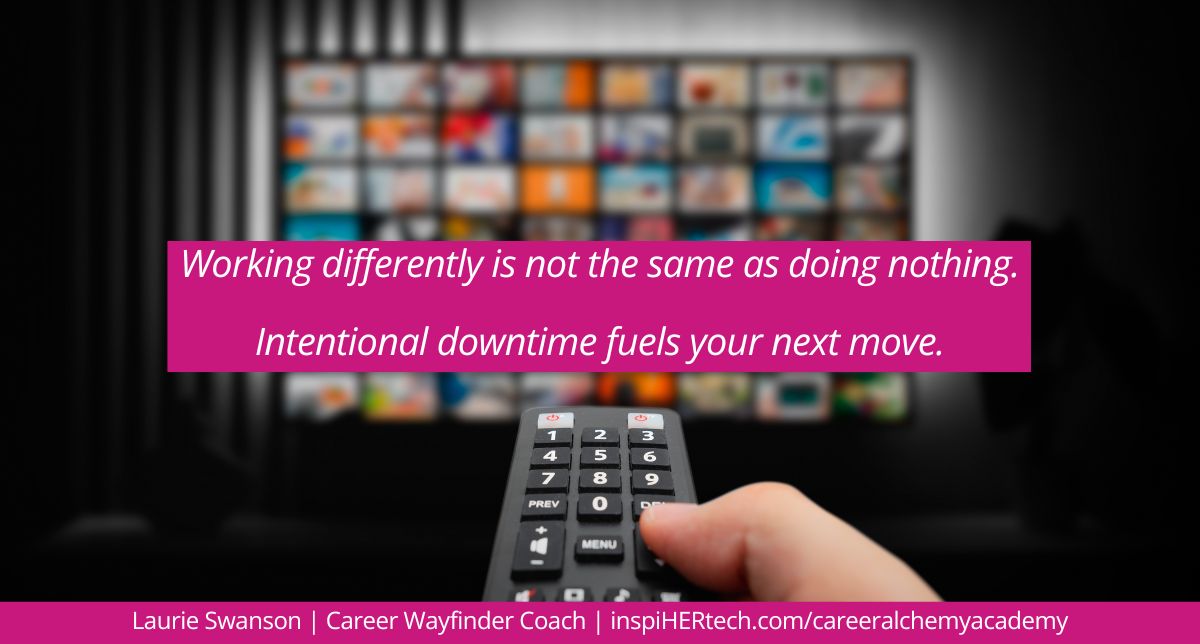
And working differently is not the same as not working.
If you’re in a slower season in your job search, your leadership role, your business, consider this alternative way to approach things … instead of finding more ways to fill the empty space, find more ways to use the space in way that prepares you for what’s next.
Sometimes that starts with deciding whether you’re going to sit down and do nothing… or lie down and do nothing. You decide. Both sound amazing to me.
|