| Recently I had a client ask me to review their resume. She was focused on having a resume that would play nice with the AI and ATS tools that companies were using to source candidates. Made sense.
The resume was good. Very good … if the only thing involved in the selection process was artificial.
The thing that was missing was her.
I couldn’t connect to the person behind the bullets.
The thing is, you need to be thinking in two steps:
- Create a resume that is AI/ATS-friendly
- Create a resume for the human being that will read it and make a decision on next steps.
It feels like an either/or. That’s where people get stuck.
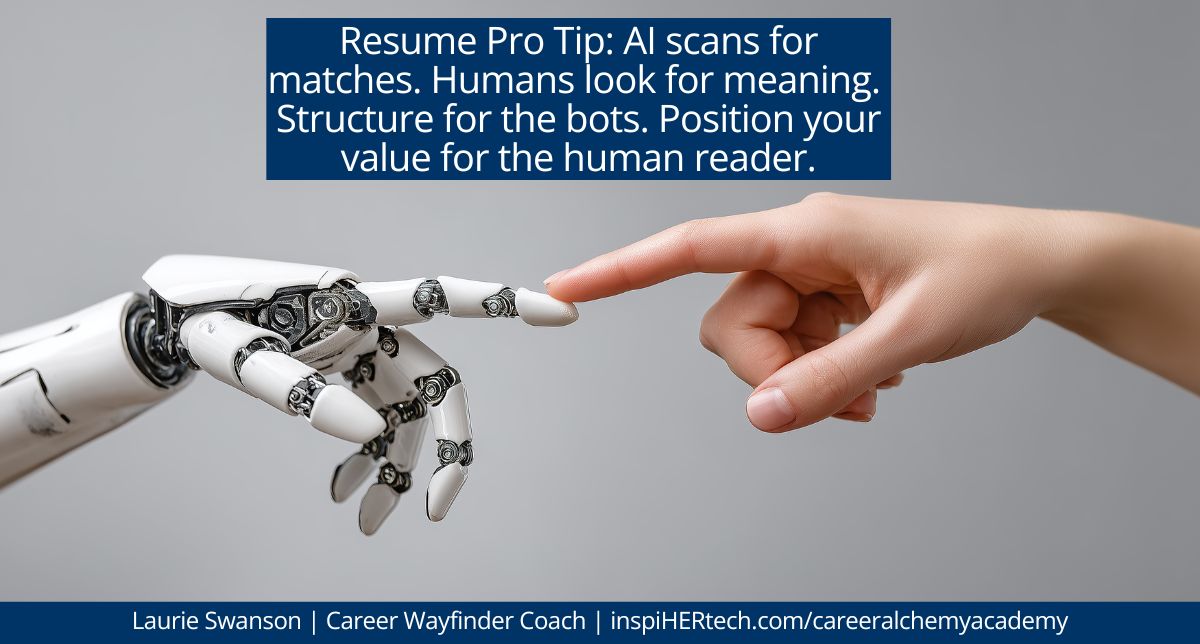
The truth is: you don’t need two resumes. You need one that’s structured for machines and readable for humans.
What AI and ATS Actually Need
AI tools and ATS systems are scanning for clarity, not cleverness.
They’re looking for:
- Clear role titles
- High-frequency searchable keywords
- Explicit skills and tools
- Consistent dates and titles
They’re not judging your voice or style. They’re answering a simpler question: “Does this person have the matching keywords and minimum experience needed for our open role?”
That means clarity beats creativity at this stage.
What Humans Care About Once You’re Found
Once your resume passes the bots, the rules change.
Humans aren’t just scanning tasks … they’re trying to feel your contribution and understand your value.
They look for three core signals:
- Experience & growth: The scope of your work and level of responsibility
- Impact: Results that show what you made happen
- How you work: Your approach, collaboration, or influence
Your goal isn’t to just check the boxes.
It’s to connect, help them see your contributions, and let them sense your story.
Humans aren’t reading bullets. They’re sensing impact. Make them feel it.
Where “Heart” Actually Comes From
Heart doesn’t come from adjectives.
It comes from self-belief.
Most people don’t struggle with resume structure. They struggle with claiming their value.
Here’s how to do it:
- Stop minimizing. If you led it, say you led it. If you influenced it, say you influenced it. Quiet competence doesn’t translate on paper.
- Write from contribution, not responsibility. Responsibilities are assigned. Contributions are chosen. That shift alone changes how you sound.
- Let your decision-making show. Humans connect to judgment, not task lists. Where did you decide, prioritize, challenge, or improve? That’s where the human shows up.
Pro Tip: You can be keyword-friendly and human at the same time.
The bottom line:
- Structure is for AI
- Emphasis is for humans
This isn’t about gaming the system … it’s about hiring as it actually works today.
It’s about remembering that on the other side of every resume is a human hoping to connect with you and feel your belief in yourself, so moving you forward in the interview process becomes a no-brainer.
|